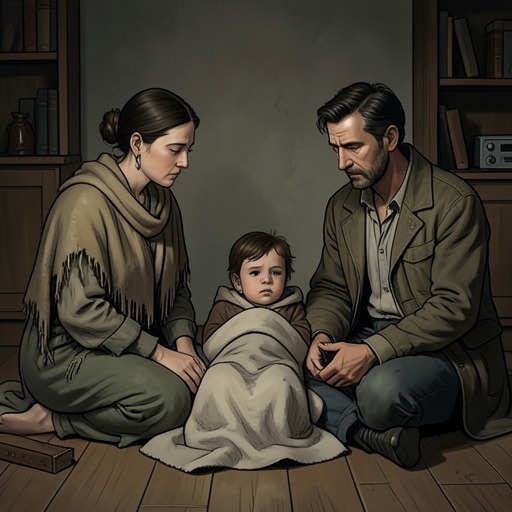
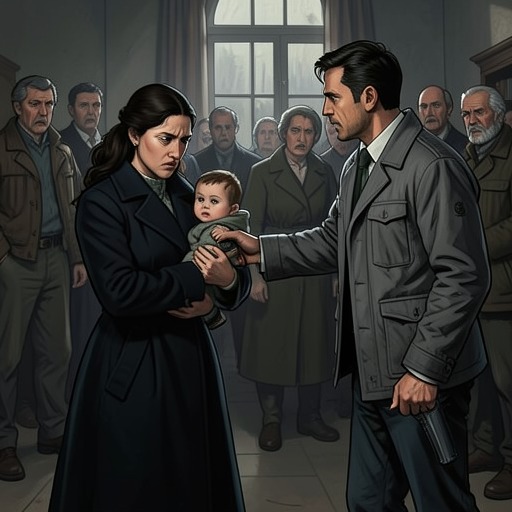
The woodcutter accepts his adopted daughter
The Most Precious of CargoesThe woodcutter accepts his adopted daughter through a change that begins in physical contact: Poor Woodcutter’s Wife catches his raised hand and holds it against the child’s chest until he feels her heart beating. His first response is violent rejection, shaped by slogans that deny the humanity of the heartless. But the child’s living body unsettles those words. In the days that follow, a tentative touch becomes a bond, and the woodcutter’s fear gives way to delight in her growth. His acceptance makes a family out of people brought together by war, poverty, and the repeated work of keeping a hungry child alive.
The Crisis at the Hut
The child’s arrival has already transformed Poor Woodcutter’s Wife into a mother, but that joy comes with immediate fear: the baby is hungry, and she has no milk. After searching for a way to feed her, the wife goes to the Man with the Goat and Shattered Face, carrying the child wrapped in the shawl that came with her. She offers firewood for milk, and the man agrees to help. His instructions are precise: goat’s milk must be diluted with boiled water for the next three months, supplemented with porridge, and later with fruits and vegetables. The wife’s daily bundles of firewood become a warm cupful of milk; by this exchange, the child endures, though hunger continues to gnaw at her.
This continuing care forms the background to the woodcutter’s change. The baby’s crying is not an abstraction in the hut: it is the sound of a child whose hunger has to be answered, day after day. One night, crying more than usual, she wakes the woodcutter from his doze. In anger he raises his hand to her. Poor Woodcutter’s Wife catches his calloused hand in midair, holds it, and redirects it toward the child rather than letting it fall. The scene turns on the difference between the word he has been taught to use for the child and the body his hand is made to feel.
The Heart Under the Slogans
The wife holds the woodcutter’s palm against the little girl’s rib cage and whispers, “Can you feel? Can you feel? Can you feel the tiny beating heart? Can you feel it? Can you feel it? It’s beating. It’s beating.” She asks him to attend to something immediate and undeniable: the small heartbeat beneath his hand. The child’s body interrupts the language of exclusion not with an argument but with a sensation he cannot dismiss while touching her.
The woodcutter roars that he wants nothing to do with the child, calling her a demon spawn and a cursed heartless creature. The wife answers him in a whisper: “The heartless have a heart. The heartless have a heart like you and me.” She insists that a heart beats in the chest of any person, adult or child. He jerks his shoulder free and repeats the period’s hateful slogans: that the heartless have no heart, that they are stray dogs to be driven out with an ax, and that they throw their children from passing trains for others to feed. His words make the scene’s conflict explicit: propaganda tries to turn the abandoned infant into an enemy, while the wife’s hand-to-hand appeal makes the child’s vulnerability present in the room.
Yet the contact has already unsettled him. As he spits out his bitterness, the warmth of the child’s skin and the pulse beneath his palm awaken an unfamiliar gentleness in him; he becomes conscious of his own heart beating, as if in time with hers. The now-calm little girl reaches her tiny hands toward him. When his wife holds the child out, he recoils again, afraid of looking at her or feeding her, even while struggling against the impulse to take her and press her to his face and beard. His response is not an instant conversion: tenderness and fear occupy him at once.
From Refusal to Kinship
The woodcutter regains his composure by returning to threat. He tells his wife that the next day she must choose between him, her honest husband, and the child she holds. Before she can answer, he collapses onto his bed. The ultimatum leaves the family’s future apparently divided between marriage and the child, but the scene has already altered the terms of that choice: the woodcutter has felt the heartbeat he had insisted did not exist.
The following day, he feels the little cargo’s heart against his palm wherever he lays his hand. In the quiet of his own heart, now filled with unfamiliar tenderness, he too calls the child his own little cargo. When they are alone, he cautiously offers her a finger; she immediately grasps it and refuses to let go. These small encounters replace the previous night’s recoiling with a repeated, chosen closeness. He does not announce a new belief or explain away his earlier hostility. Instead, the change appears in what he allows the child to touch, and in the joy he finds in her response.
The turning point becomes unmistakable when the girl crawls across the hut, grabs the cuff of the woodcutter’s trousers, and pulls herself upright by clutching a patched knee. He calls urgently for Poor Woodcutter’s Wife to come and see. The girl balances while holding on with one hand, then releases the trousers in an attempt to clap and falls onto her backside, laughing. The woodcutter scoops her up and raises her like a trophy, crying, “Hallelujah!” His excitement makes the child’s ordinary milestone a shared family event: the man who once lifted his hand against her now lifts her in celebration.
A Family Remade by Care
In the days after the girl’s first attempt to stand, the woodcutter and Poor Woodcutter’s Wife feel less keenly the cold, hunger, poverty, and wretchedness of their circumstances. Their happiness does not end the war or remove their deprivation. Rather, the child changes how those conditions are lived: the couple experience the world as lighter and more secure because the war has brought them what the narrative calls its most precious cargo. Their shared happiness is pictured as a bundle brightened by the wildflowers of early spring, a domestic reprieve set against the hardship that remains.
The child’s survival and the woodcutter’s acceptance are both made possible through practical acts of care. Poor Woodcutter’s Wife risks herself in seeking milk and keeps returning with firewood; the Man with the Goat and Shattered Face gives milk while refusing to be praised or have his gift exposed; the woodcutter finally answers the child not with the slogans he repeats but with attention, touch, and delight. His acceptance therefore completes neither the material struggle nor the danger surrounding the family. Later, when the armed old man asks for the precious cargo and leads them away, Poor Woodcutter’s Wife entrusts him with the child, who is received with gentle dignity. The family bond is real, but care also requires choices about how to protect the child beyond the hut.
Narrative Significance
The acceptance scene reverses the public claim that the heartless have no heart through a private test of touch. The woodcutter begins with the child as a category condemned by propaganda; his wife makes him feel the heartbeat that category denies. The narrative then measures his change through recurring bodily gestures: a hand held against the baby’s chest, a finger grasped by her small hand, her grip on his patched trousers, and his arms lifting her in triumph. Kinship is not presented as a declaration alone, but as a relationship formed through contact, repeated care, and pleasure in the child’s life.
The event also binds the woodcutter’s acceptance to the labor that sustains the child. Milk is not supplied by a miraculous transformation: the wife must bargain for it, carry firewood, and return each morning. The child remains hungry even after she is restored to health, and the couple remain poor in a country at war. Against those limits, the woodcutter’s change is consequential without being effortless. He first threatens to make his wife choose, then begins to call the girl his own; the story locates his moral turning not in the disappearance of danger, but in his willingness to recognize and cherish the life his earlier words had denied.